


CORN COMMENTS
NO NEW RECOMMENDATIONS
Corn futures edged 1 3/4 to 2 1/2 cents higher in rangebound trade on support from a weaker dollar, easing concerns about trade tensions spurred by U.S. efforts to gain control of Greenland and worries about continued dry conditions in Argentina’s southern growing areas. Expectations for USDA to report a strong weekly export sales total on Friday also likely supported prices. Mar. corn rose 2 1/4 cents to $4.24, while May futures rose 2 1/2 cents to $4.32 1/4 and July rose 2 1/4 cents to $4.38 1/2.
Futures traded narrow ranges of 3 1/4 cents or less today and the price chart picture is looking uncertain right now. Trading seems likely to remain choppy on Friday. The 2025-crop futures contracts failed to show any follow-through to Wednesday’s bearish finish and settled near their contract highs, which may spur some short covering and speculative bargain hunting overnight. Nearby Mar. futures now have nearby chart support at $4.17 1/4-$4.21, with nearby resistance at $4.27 3/4. A close above $4.27 3/4 might open further near-term upside to $4.35-$4.40, while a close below $4.19 3/4 would be bearish.
Tomorrow’s USDA report is expected to peg net U.S. corn export sales for the week ended Jan. 15 at 75.0 to 149.5 mil. bu. far above the previous week’s sales of 45 mil. bushels. Strong export sales should be partly built into the market, though after USDA previously reported 64.9 mil. bu. worth of sales through its daily reporting system last week. USDA did revise one daily sales announcement lower by about 7.1 mil. bushels. Weekly U.S. export shipments may be down marginally from the previous week’s 61.2 mil. bu., based on weekly export inspections of 58.4 mil. bushels.
Efforts to get rules allowing year-round sales of E-15 gasoline nationwide in the current spending bill have failed. Republican lawmakers plan to create a task force to study potential year-round E-15 sales, but that is basicallly just another way of kicking the E-15 can down the road.
The Buenos Aires Grains Exchange today estimated that 93.1% of Argentina’s 2025-26 corn crop had been planted by Wednesday. The Exchange rated corn crop conditions 52% good/excellent, 37% “normal” and 11% poor/very poor, up from 64% good/ex., 31% “normal” and 5% poor/very poor a week earlier. The exchange noted that localized yield losses are being observed in southern Cordoba province due to hot, dry weather and also noted that increases in leaf hopper populations were beginning to alter management decisions in north-central Santa Fe, where some unplanted second-crop corn area could be switched to soybeans.
CIF basis bids for delivery of corn to the U.S. Gulf are stronger vs. Wednesday afternoon amid strong demand and worries about shipping delays on Midwest rivers. Frigid temperatures are slowing barge loadings around the region. The CIF bid for January delivery is 4 cents stronger at 93 over Mar. futures, with the bid for February delivery 2 cents stronger at 93 over, while the bid for March delivery is 3 cents stronger at 93 over.
SOYBEAN COMMENTS
NO NEW RECOMMENDATIONS
Soybean futures mostly eked out small gains of 1 1/4 to 3 1/4 cents, while nearby Mar. futures slipped 1/2 cent in thin, choppy trading. Easing concerns about tensions over Greenland, a weaker dollar and concerns about hot, dry weather in southern Argentina were supportive market factors. The absence of any fresh Chinese demand for U.S. soybeans limited futures strength. Mar. soybeans fell 1/2 cent to $10.64, while May rose 1 1/4 cents to $10.76 1/4 and July rose 1 3/4 cents to $10.89. Mar. soyoil futures fell 23 points to 53.78 cents, while Mar. soymeal futures rose $4.80 to $296.20.
Soybean futures started strongly overnight, but failed to hold early strength and finished in the bottom third of their daily ranges. Mar. soybeans pushed to a 16-session high of $10.72 1/2 on this morning’s open, but settled 8 1/2 cents off of that high. The market still needs to close above its Jan. 12 reversal high of $10.71 1/4 to invalidate that reversal and confirm a significant low. However, Mar. has already broken the short-term downtrend line off its Nov. 18 high and we do expect the market’s next move will be higher. Mar. should have nearby support in the $10.50-$10.53 area on any near-term weakness. Nov. soybeans also failed to hold a move to a 16-session trading high of $10.81 1/2., but did post their highest close in 17 sessions at $10.77 1/4.
USDA is expected to report net U.S. soybean export sales for the week ended Jan. 15 at anywhere from 29.5-110.0 mil. bu. compared with the previous week’s sales of 76.2 million. Weekly soybean export shipments may be down from the previous week’s 60.2 mil. bu., based on weekly export inspections of 49.1 mil. bushels.
The big problem right now is that now that China has fulfilled its commitment to buy 12 MMT of U.S. soybeans for 2025-26, the market needs to see other buyers step up to the plate to replace Chinese demand. Although China has supposedly committed to buy 26 MMT of U.S. soybeans for 2026-27, it is unlikely to start booking any purchases for next marketing year before summer. Meanwhile, new-crop Brazilian beans are priced well below U.S. beans for spring delivery. Brazilian beans for March shipment from the port of Santos on a Free-on-Board (FOB) basis are priced at 42 cents over CBOT Mar. futures, while U.S. beans for FOB shipment from the Gulf are priced at 115 cents over.
The Buenos Aires Grains Exchange estimated that 96.2% of Argentina’s intended 2025-26 soybean area had been planted by Wednesday. The Exchange rated soybean crop conditions 53% good/excellent, 34% “normal” and 13% poor/very poor, down from 61% good/ex., 35% “normal” and 4% poor/very poor a week earlier. The exchange reported a lack of soil moisture in southern Cordoba and western Buenos Aires.
CIF basis bids for delivery of soybeans to the U.S. Gulf are fully steady vs. Wednesday afternoon. The bid for January delivery is at 106 over Mar. futures, while the bid for February delivery is at 102 over and the bid for March delivery is at 100 over.
WHEAT COMMENTS
NO NEW RECOMMENDATIONS
Wheat futures, driven by technically-driven short-covering and bottom-picking, along with support from winterkill worries in the U.S. and in Russia. Chicago wheat gained 7 to 8 cents, settling at $5.15 ½ in the March, $5.26 ½ in the May, and $5.39 in the July. Kansas City wheat was up 4 to 6 cents, settling at $5.25 ¾ in the March, $5.36 in the May and $5.48 ¼ in the July. Minneapolis wheat was up 9 ¼ to 10 cents, settling at $5.73 ¾ in the March, $5.85 ¼ in the May and $5.96 ½ in the July.
While Chicago and Kansas City are stuck in a sideways trend near-term, spring wheat broke out today, rising to its highest level in 10 days in the March contract. This is after making a new contract low of $5.60 ½ on Friday. But the market only took out the previous contract low by ½ cent and saw no follow-through, and now the near-term picture is looking much brighter. March spring wheat has been trading a sideways range of $5.60 to $5.90 since October.
Chicago wheat traded a range of $5.07 to $5.28 on Jan. 12, the day of the bearish USDA reports, and has remained within that range since. March futures did find support at $5.07 yesterday, and that now looks like significant support. The contract low is at $5.01 ½.
A winter storm is still expected to bring beneficial moisture to the southern Plains starting Friday. Before the snow begins though, subzero morning temperatures in Nebraska and the most northern counties in Kansas on Friday could cause some winterkill, World Weather Inc. says. This area has no snow on the ground and won’t get snow on the ground until mainly after Friday morning. The moisture that does fall should be beneficial to HRW as well as SRW wheat in the Delta region and parts of the Midwest.
Significant cold weather will affect the Former Soviet Union region today through Sunday before a warming trend arrives, World Weather Inc. says. The coldest air will occur across central and northern production areas of Russia. World Weather sees no concern of any winterkill due to the entire region having favorable snow cover, however, Moscow-based consultancy SovEcon said it may cut its 2025-26 Russian crop estimate if the cold spell persists for a week or more.
COTTON AND RICE COMMENTS
NO NEW RECOMMENDATIONS
Cotton futures settled lower for the fifth straight day amid technical selling. March cotton lost 42 points, settling at 63.88 after trading a range of 63.81 to 64.47. May cotton was down 43 points to 65.49, and July was down 43 points to 66.97. The market posted a bearish outside day lower for the second time in three days, and fell to its lowest level since Jan. 2. Last week the market was unable to close above the 65-cent level, and futures could be headed for a test of the contract low of 62.97 in the March contract.
Fundamentally, the market may be getting some pressure from the storm system set to dump rain, snow and ice from West Texas through the Delta region and over to the East Coast. Moisture totals could be substantial for much of the region, which remains in drought conditions. Relief in south Georgia and the Carolinas, however, looks to be minimal. Traders await weekly export sales, to be reported tomorrow morning. Last week’s total was a marketing-year high.
Rice futures paused after settling higher each of the prior four days. The market settled down 10 ½ cents in both March and May futures. March settled at $10.68 ½ after trading a range of $10.62 ½ to $10.78 ½, while May settled at $10.96. March futures couldn’t take out yesterday’s two-month high before retreating.
LIVESTOCK COMMENTS
NO NEW RECOMMENDATIONS
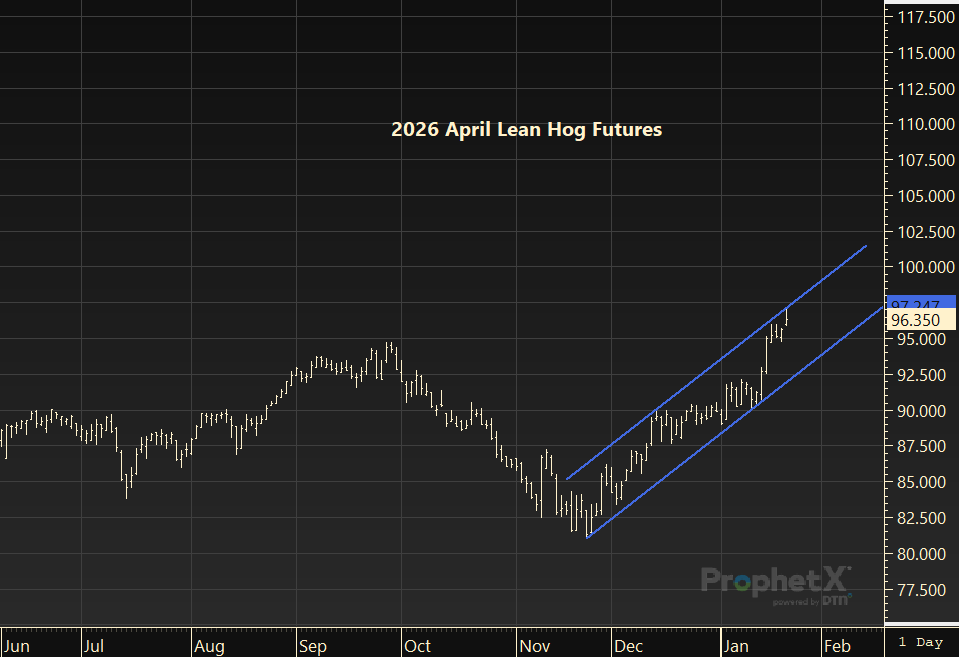
LEAN HOG FUTURES managed further gains ranging from 20 to 75 cents on support from stronger cash hog and wholesale pork prices as well as technically-driven buying, but speculative profit taking set in, pushing futures off their early highs. Feb. futures rose 63 cents to $88.48, while April futures rose 75 cents to $96.35 and June futures rose 45 cents to $108.63.
Lean hog futures remain technically strong, with all deferred contracts charting new contract highs today, but futures are also now overbought on short-term momentum indicators, which may limit further near-term buying interest. Most-active April lean hogs now have chart resistance at $97.05, with nearby support at $95.73-$95.83. April stopped at the top of its upward trading channel today, which may be significant. June futures have also moved near the top of their trading channel and now have chart resistance at $109.20, with nearby support at $108.20.
The composite pork cutout value rose 64 cents to $94.62, while the national avg. negotiated cash carcass value fell $2.04 to $83.09. The midafternoon weighted avg. price for hogs sold under swine/pork market formula agreements was $82.53, up 39 cents from Tuesday. Today’s estimated slaughter ran 490,000 head, down 2,000 from last week, but up 27,000 from last year.
LIVE CATTLE FUTURES wound up anywhere from 73 cents lower to 3 cents higher in thin, choppy trade as market participants awaited fresh activity in Plains cash markets and Friday’s USDA report. Feb. futures fell 73 cents to $232.38 and most-active April live cattle fell 13 cents to $234.82.
FEEDER CATTLE FUTURES also put in a mixed finish settling between 10 cents lower and 55 cents higher in cautious trading as market participants watched for fresh news. Most-active Mar. futures fell 10 cents to $359.28, while May futures fell 10 cents to $355.48.
Live cattle futures have spent the week consolidating inside of last Friday’s price ranges ahead of Friday’s USDA report, with a lack of cash market activity and uncertainty about the New World Screwworm situation helping to keep traders cautious. Most-active April live cattle now have nearby chart resistance at $235.50, with nearby support at $234.33 and $232.95 and key support at Friday’s low of $231.28. Most-active Mar. feeder cattle futures have nearby chart resistance at $360.53, with nearby support at $358.43 and $355.30-$356.10. Key resistance is up at Friday’s reversal high of $365.00.
Plains cash cattle markets remained largely quiet at mid-afternoon. Some packer bids have emerged at $232 on a live basis in Nebraska, but Wednesday’s packer bids at $233 live in Kansas were not repeated today. Feedlot asking prices of $370 on a dressed carcass basis have been reported in Nebraska, but no asking prices have been established in the southern Plains. USDA reported minimal negotiated trade in Nebraska of 85 head at $365 dressed as of midafternoon. It looks like it will be Friday before trade develops, perhaps not until after the USDA report. Beef cutout values ranged 72 cents lower to $1.34 higher this afternoon, with the choice cutout rising to $367.45.
Trade estimates of the Jan. 1 feedlot inventory avg. 96.8% of a year earlier in a range from 96.0-97.6%, while pre-report estimates of December feedlot placements avg. 93.5% of a year earlier in a range from 88.0%-98.5%, according to a Reuters News Service survey of 12 analysts. Feedlot marketings. Expectations for feedlot marketings avg. 101.5% of a year earlier, in a range from 100.0-102.0%.
BROCK MARKET POSITIONS
CORN: Cash-only Marketers: 2024 CROP:100% sold on hedge-to-arrive contracts and regular forward contracts (7-19-23, 8-15-23, 1-2-24, 5-8-24, 5-15-24, 5-16-24, 5-30-24, 11-12-24, 12-12-24, 2-5-25, 2-21-25, 6-5-25, 6-20-25).
2025 CROP: 40% sold on hedge-to-arrive contracts (2-5-25, 2-24-25, 6-9-25, 7-9-25, 1-9-26).
Hedgers: 2024 CROP: 100% sold on hedge-to-arrive and regular forward contracts (7-19-23, 8-15-23, 5-8-24, 5-16-24, 11-12-24, 12-12-24, 2-5-25, 2-21-25, 4-15-2025, 6-5-25, 6-20-25).
2025 CROP: 40% sold on hedge-to-arrive contracts and regular forward contracts (2-5-25, 2-24-25, 6-9-25, 7-9-25, 1-9-26); aside futures; short July 2026 $5.40 call options against 10% (6-6-25).
SOYBEANS: Cash-only marketers: 2024 CROP: 100% sold (7-19-23, 8-22-23, 11-16-23, 5-16-24, 10-8-24, 12-18-24, 2-5-25, 2-12-25, 2-26-25, 6-2-25, 6-23-25).
2025 CROP: 50% sold on hedge-to-arrive contracts or regular forward contracts (2-12-25, 6-23-25, 7-9-25, 9-2-25, 11-4-25, 12-1-25).
Hedgers: 2024 CROP: 100% cash sold (7-19-23, 8-22-23, 11-16-23, 5-9-24, 12-18-24, 2-5-25, 2-26-25, 4-15-25, 4-29-25, 6-2-25, 6-23-25).
2025 CROP: 50% sold on hedge-to-arrive contracts or regular forward contracts (2-12-25, 6-23-25, 7-9-25, 9-2-2025, 11-4-25, 12-1-25), aside futures, long $10.50 February put options on Mar. 2026 futures against 20% (1-9-26).
SRW WHEAT: Cash-only Marketers: 2025 CROP: 80% sold on hedge-to-arrive and regular forward contracts (5-30-24, 6-4-24, 10-15-24, 2-24-25, 6-9-25, 6-10-25, 6-24-25, 11-6-25), aside futures. 2026 CROP: No sales advised.
Hedgers: 2025 CROP: 70% sold on hedge-to-arrive and regular forward contracts (5-30-24, 10-15-24, 2-24-25, 6-9-25, 6-10-25, 6-24-25, 11-6-25);. 2026 CROP: No sales advised.
HRW WHEAT: Cash-only Marketers: 2025 CROP: 80% sold on hedge-to-arrive and regular forward contracts (5-30-24, 6-4-24, 10-15-24, 2-24-25, 6-9-25, 6-10-25, 6-24-25, 11-6-25).
Hedgers: 2025 CROP: 70% sold on hedge-to-arrive and regular forward contracts (5-30-24, 10-15-24, 2-24-25, 6-9-25, 6-10-25, 6-24-25, 11-6-25); aside futures. 2026 CROP: No sales advised.
LEAN HOGS: Aside futures and options.
LIVE CATTLE: Short Feb. 2026 live cattle futures on 50% of 1st qtr. marketings (1-16-26); short April 2026 live cattle futures on 25% of 2nd qtr. marketings (1-16-26)
FEEDER CATTLE: Feeder sellers are short Mar. 2026 feeder cattle futures on 50% of 1st qtr. marketings (1-16-26); short May 2026 feeder cattle futures on 25% of 2nd qtr. marketings (1-16-26). Feeder buyers remain aside futures.
MILK: No forward cash sales advised; aside futures.
FEED BUYERS: CORN: No forward cash purchases advised. SOYMEAL: 100% of 1st qtr. needs bought in the cash market; 50% of 2nd qtr. needs bought in the cash market (1-7-26).
COTTON: Cash-only Marketers: 2024 CROP: 100% sold (2-12-24, 2-27-24, 4-3-24, 6-27-24, 6-28-24, 3-13-25, 3-18-2025, 4-28-25, 6-24-25, 7-16-25). 2025 CROP: 10% sold in the cash market (9-17-25).
Hedgers: 2024 CROP: 100% cash sold (2-12-24, 2-27-24, 4-3-24, 6-27-24, 3-13-25, 3-18-25, 4-28-25, 6-24-25, -16-25), aside futures: 2025 CROP: 10% sold in the cash market (9-17-25). Aside futures.
RICE: 2024 CROP: 100% sold (5-3-24, 5-8-24, 5-28-24, 5-29-24, 7-15-2024, 7-30-24, 9-24-24, 2-21-25. 4-29-25, 7-18-25). 2025 CROP: 10% forward contracted (6-9-25).


