


CORN COMMENTS
ADVICE REMINDER: Corn hedgers should have bought July 2026 corn futures against 10% of 2025 production to exit the previously advised short position. Hedgers should also have bought March 2027 corn futures against 15% of expected 2026 production to exit half of the previously advised short position. We remain short March 2027 futures against 15% of expected 2026 crop.
Corn futures finished another choppy session 1 cent lower to 3/4 of a cent higher, with most contracts fractionally lower under pressure from crude oil market weakness and favorable Corn Belt weather forecasts. Good export demand and oversold market conditions limited price weakness. Nearby July corn rose 3/4 of a cent to $4.19 1/2, while Sep. corn held steady at $4.27 1/2 and Dec. corn fell 3/4 of a cent to $4.45 1/4.
Corn futures have stabilized, but we can’t say right now whether they have bottomed or are simply consolidating ahead of another downward move. Futures finished near their session lows, which may generate fresh fund long liquidation. Traders may stay cautious ahead of Thursday morning’s USDA report, though, even though major changes in USDA’s corn supply/demand balance sheets are unlikely.
July corn futures now have nearby chart resistance at $4.25 1/2, with nearby support at $4.17 1/2 and $4.12 1/2. July could potentially rally back above $4.30 without pushing back above its 10-day moving average. Dec. futures have nearby chart resistance at $4.51 1/2, with nearby support at $4.43 3/4 and $4.39-$4.41. The market’s 10-day moving avg. should be near $4.59 tomorrow. July and Dec. futures are extremely oversold on short-term momentum indicators, with their 14-day relative strength index readings at 9.16% and 9.62% respectively, so we will be keeping a close eye on our remaining 2026-crop hedge position.
Wednesday morning’s weekly EIA report is expected to peg U.S. ethanol production for the week ended June 5 at 1.110-1.125 mil. barrels per day, vs. the previous week’s 1.108 million. June 5 U.S. ethanol stockpiles are expected to total 24.400-24.806 mil. barrels, vs. stocks of 24.606 mil. a week earlier.
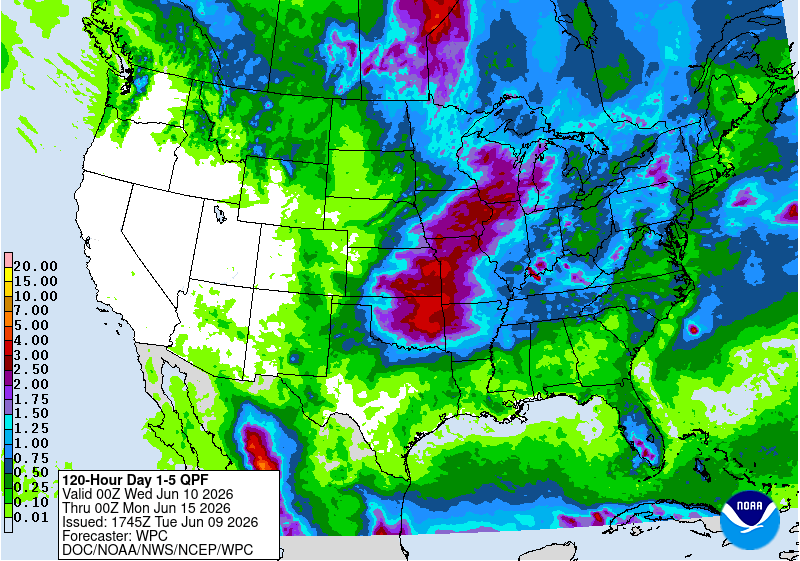
The NWS 5-day precipitation outlook now calls for heavy rains across a broad swath of the western Corn Belt from eastern Kansas through Missouri, much of Iowa, northwest Illinois and Wisconsin by Monday morning, with amounts ranging from 2 to more than 4 inches. The weather model is likely overdoing the rainfall, but significant coverage is likely. Weather forecasts continue to look mostly favorable for at least the next two weeks, with the NWS 6- to 10-day and 8- to 14-day outlooks both calling for mild temperatures and near-normal/above-normal rainfall, which should maintain strong yield potential.
Central Illinois processor spot corn basis bids are steady, ranging from 10 under July futures to 15 over, according to USDA. CIF basis bids for delivery of corn to the U.S. Gulf are stronger vs. Monday afternoon amid continued weak futures prices and slow farmer selling. The CIF basis bid for June delivery is 1 cent stronger at 75 cents over July futures, with the bid for July delivery 3 cents stronger at 87 over, while the bid for August delivery is 3 cents stronger at 87 over Sep. futures.
SOYBEAN COMMENTS
NO NEW RECOMMENDATIONS
Soybean futures extended their losing streak to 8 sessions, sinking another 2 to 4 3/4 cents under pressure from favorable U.S. weather forecasts, ongoing concerns about export demand and declining crude oil prices. Further weakness in soymeal prices were also a negative market factor, while the soyoil market held firm despite the crude oil losses. Nearby July soybeans fell 2 cents to $11.13 3/4, while Aug. fell 2 1/2 cents to $11.18 3/4 and Nov. fell 3 1/2 cents to $11.32. Most-active July soyoil futures rose 52 points to 74.91 cents, while July soymeal fell $1.60 to $301.10.
As expected, although Monday afternoon’s U.S. soybean crop rating was slightly lower than expected, it failed to provide significant support for futures prices, given the favorable looking U.S. weather outlook, which no doubt spurred expectations for improving ratings. If anything, right now, the forecast looks a bit too cool and wet for optimal soybean development in some areas.
Soybean futures, like corn futures, managed to stabilize somewhat today, but still put in a soft close, settling near their session lows. We expect traders to turn very cautious now ahead of Thursday morning’s USDA report. Although no big changes are expected in USDA’s soybean supply/demand balance sheets, we suspect we will see a further cut to projected old-crop exports.
Also like corn futures, soybean futures are extremely oversold on short-term technical indicators, which could set the stage for at least a significant short-term price bounce. The 14-day relative strength index readings for July and Nov. soybeans are now at 9.68% and 14.68% respectively. July soybeans now have nearby chart support at $11.10 1/4 and $10.00-$11.00, with further support at $10.95, while nearby resistance is at $11.18 1/2 and $11.25 1/4. Nov. soybeans traded inside of their Monday range and have nearby chart support at $11.28 3/4-$11.29 3/4 and $11.18, while their 200-day moving avg. is at $11.13 1/2. Nov. has nearby resistance at $11.37 1/2 and $11.42.
Central Illinois processor spot soybean basis bids are steady, ranging from par with July futures to 20 over, according to USDA. CIF basis bids for delivery of soybeans to the U.S. Gulf steady to weaker vs. Monday afternoon. The CIF basis bid for June delivery is steady at 70 over July futures, while the bid for July delivery is 1 cent weaker at 88 over and the bid for August delivery is 2 cents weaker at 85 over Aug. futures.
WHEAT COMMENTS
NO NEW RECOMMENDATIONS
Wheat futures were mixed, with gains in nearby Chicago contracts and Kansas City, while other contracts were lower. Benchmark Chicago July soft red winter wheat futures settled up 2 cents to $5.85 ¼, and September was up 1 cent to $5.96 ¾. December was up ½ cent to $6.14 ¼. But other contracts were lower. Kansas City wheat was up ¼ to 1 cent, settling at $6.30 ¾ in the July, $6.40 in the September and $6.54 ½ in the December. Minneapolis spring wheat was lower, losing 1 to 2 cents, and settling at $6.17 ½ in the July, $6.43 ¼ in the September and $6.65 ¾ in the December.
Technically, Chicago wheat is looking encouraging, settling higher for the second day in a row after a two-week losing streak, with follow-through to Monday’s bullish reversal off a multi-month low. Kansas City was also up for a second day in a row. But Minneapolis spring wheat made a three-month low again today, and ended on session lows. The December contract yesterday actually posted a bearish outside day down, and with today’s follow-through this market, unlike Chicago and K.C., shows no sign of bottoming yet.
Futures had support from speculative short covering, some of which may be position evening ahead of Thursday’s USDA Crop Report. Monday’s further decline in the U.S. winter wheat crop condition rating has also been a supportive market factor, while harvest pressure and an improved spring wheat crop rating are negative market factors along with ample world wheat supplies.
USDA’s winter wheat crop condition rating of 25% good/ex. as of Sunday was the lowest for week 23 of the year on record going back to 1986 as last week’s rains in the HRW wheat belt were mostly too late to help the crop there. USDA is expected to lower its U.S. winter wheat crop estimate slightly on Thursday.
Pre-report trade estimates of 2026 U.S. all-wheat production avg. 1.555 bil. bu., 6 mil. below USDA’s May estimate, while estimates of winter wheat production avg. about 1.041 bil. bu., 7 mil. below USDA’s May estimate, with estimates of HRW wheat production averaging 508 mil. bu., 7 mil. below USDA’s May estimate, according to a Bloomberg News survey.
COTTON AND RICE COMMENTS
NO NEW RECOMMENDATIONS
Cotton futures stumbled badly, dropping more than 2 cents and settling lower for the fifth day in a row. July cotton lost 2.13 cents to 71.26, after trading a range of 71.08 to 73.86. IOt made a fresh two-month low and looks poised to test the 70-cent level. December cotton fell 2.31 cents to 75.30.
In the first cotton condition ratings of the season yesterday, USDA reported 53% of the cotton crop rated good/excellent, up from the five-year average of 49%. It has been a difficult spring in much of the south due to drought, and Georgia’s good/excellent rating of 57% is down from the average of 66%. But the biggest factor for the U.S. crop is Texas, and its rating starts out at 45%, up from a five-year average of 33%. Planting meanwhile is 77% done, in line with the five-year average and up from 66% last week. Texas was 68% planted, up from 58% last week, and Georgia was 85% planted, up from 72% last week.
Rice futures were down 7 to 8 cents. July settled at $12.39, after trading a range of $12.34 to $12.65 ½. September settled at $12.75 ½. Trading volume was low.
The market’s downside should be limited by questions about this year’s crop. We think U.S. acreage could drop further in the June acreage report at the end of the month. And the crop that is planted in the Mid-South is struggling. Overall, USDA reported the rice crop was 70% good/excellent as of Sunday, down two points from last week. But the condition of the Arkansas crop continues to deteriorate, and was at 59% as of Sunday, down from 63% a week earlier.
LIVESTOCK COMMENTS
NO NEW RECOMMENDATIONS
LEAN HOG FUTURES fell for a fourth straight session, posting further losses ranging from 45 cents to $1.45 under pressure from ongoing demand concerns spurred by continued high hog weights and disappointing wholesale pork prices, as well as fund long liquidation. Most-active July futures fell $1.23 to $96.15, while Aug. futures fell $1.45 to $94.70 and Oct. futures fell $1.35 to $81.00.
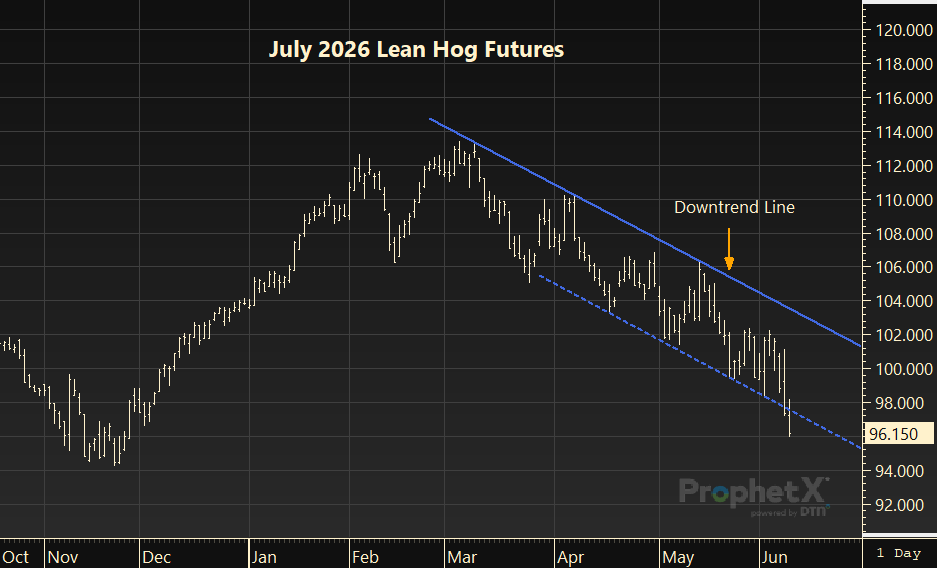
Most-active July futures charted their lowest close since Nov. 25 after trading as low as $95.93 and appear set to test their major November low at $94.20. Aug. hogs have nearby chart support at $94.30 and major support at $93.68-$93.90, their November lows. Open interest has been falling on this latest sell-off over the past 4 sessions, indicating index fund long liquidation, not new selling is the primary driver of the weakness, so a price bottom may finally be near, however, wholesale pork market action is not encouraging.
The composite pork cutout value slid another $2.50 to $95.96 on a further $3.38 drop in the loin component. On the positive side, the midafternoon national avg. negotiated cash carcass value was $1.27 higher at $97.48, but the midafternoon weighted avg. price for hogs sold under swine/pork market formula agreements was 27 cents lower at $91.20. Daily estimated hog slaughter was 485,000 head, down 2,000 from last week but up 4,000 vs. last year.
LIVE CATTLE FUTURES rallied back from early weakness in choppy trade to post gains ranging from $1.50 to $2.98 on apparent support from their discounts to cash amid continued uncertainty in the market about the impact of the New World screwworm (NWS) situation. Most-active Aug. live cattle rose $1.50 to $248.03 while Oct. futures rose $2.98 to $239.70.
FEEDER CATTLE FUTURES also recovered from a weaker start to post gains ranging from $2.70 to $3.45 on support from stronger cash prices and live cattle market gains. Aug. feeder cattle rose $3.45 to $354.15, while Sep. feeders rose $3.25 to $350.70. The CME cash feeder cattle index rose $1.19 this afternoon to $368.20.
Live cattle futures found support above last week’s reversal lows and finished several dollars off their session lows and nearly on their highs, so it appears key support has been established for now. Aug. live cattle have strengthened support at $233.98-$235.15. The market’s 10-day moving avg.is at about $240.00, with nearby chart support at $243.25-$245.23. Oct. live cattle have nearby chart support at $227.90 and $225.38, with nearby resistance at $236.15 and $238.15. Aug. feeder cattle futures have established nearby support at $349.00-$349.05 and have nearby resistance at $355.08 and $358.55-$358.75.
Plains direct cash cattle markets stayed quiet today with feedlots passing on packer bids at $403 on a dressed basis in Nebraska. No packer bids have been established in the southern Plains, while some feedlot asking prices have emerged at $458-$460. Overall, the market appears set up for largely steady prices with last week, but we don’t expect to see significant trade before Wednesday afternoon at the earliest.
Beef cutout values ranged from $1.16 lower to 70 cents higher this afternoon, with the choice cutout at $392.90. Today’s cattle slaughter was estimated at 109,000 head, down 1,000 from last week and 9,000 from last year.
Click Here to View THE BROCK REPORT Position Monitor
NOTE: Along with the potential for profit, there is always a risk of losing money when trading futures and options contracts.
Copyright 2026 by Richard A. Brock & Associates, Inc.
Any unauthorized redistribution or reproduction of this commentary is strictly forbidden.


