LEADING OFF: Grain and oilseed futures are mostly higher to start the week, with corn and soybeans getting some support from excessive rains across a large part of the Midwest. Corn is up 1 to 2 cents, and soybeans are up 5 to 6. Wheat however is lower, with Chicago down 4 to 5 cents. Cotton is up 20 points.
In outside markets, crude oil is up 60 to 70 cents on the ongoing war in the Middle East and the prospect it could further spread regional instability. This morning President Trump threatened to bomb Oman if it gets in the way of U.S.-Iran negotiations. Gold is up slightly, and the dollar index is down 0.2%. U.S. equity futures are pointing to a weaker open for the stock market.
An ongoing story this week will be the Pro Farmer Crop Tour, which serves as the first large-scale physical check of the crop and a comparison with USDA assumptions. The utility of the findings are debated and in most years it has little market impact, but there have been years where it becomes a significant story. There will be a lot of noise on a daily basis, largely on social media, but the main “news’ will be in the daily roundups and projections each evening, and then Friday’s Pro Farmer official crop estimate, which is informed by the tour but not just an average of tour samples. The first day of the tour could find some troubled conditions as scouts on the eastern end of the tour go from central Ohio to central Indianapolis, which has been hammered by extreme rains and flooding in the past week, while in the west scouts move from eastern South Dakota into Nebraska, where drought has been an ongoing issue this summer.
CORN: With more torrential rains across the heart of the Corn Belt over the weekend, the question has become whether it is too much of a good thing. It certainly is too much across parts of central Illinois, central Indiana and central Ohio, with more than six inches falling over the past week in some spots and more than 10 inches in some parts of central Indiana, which has caused extensive flooding. Much of those states saw less rain but still more than 5 inches over the past week. But some areas of the central and northern Plains have seen healthy rains of more than two to three inches, and given the ongoing concern about dryness there, the moisture could be a “big boon for spring and summer crops” according to World Weather.
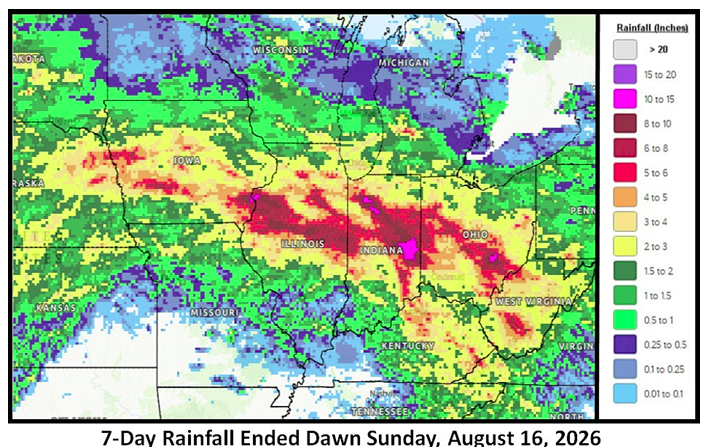
Now much of the Midwest needs some time to dry out, but the forecast does not look fully cooperative. “This week’s weather will generate a few showers and thunderstorms periodically which may slow the needed drying trend,” World Weather says, adding that temperatures will also be milder than usual.
We suspect Monday’s U.S. corn crop rating may hold steady again at 61% good/excellent, although there is a question over how USDA will assess crops in areas that have been flooded.
SOYBEANS: Traders will get a fresh read on soybean crush demand when NOPA issues its monthly Crush report at 11 a.m. CT. Analysts on average see the crush coming in at 221.51 million bushels, but estimates range from 215.00-225.99 million in a Reuters poll. At the average estimate, the July NOPA crush would be up 3.3% from June to a 4-month high and would be up 13.2% from the July 2025 crush of 195.70 million bushels, which was a record high for the month. Soybean oil stocks are seen on average at 1.454 billion bushels in a range from 1.380-1.532 billion.
There were no fresh export sales to China announced this morning, the first time in a week that has happened. Soybeans could find further support from all of the rain across the Midwest. Along with mild temperatures, this is not a good setup for the crop in what is typically the most important month for yields. Pro Farmer’s tour this week measures pod counts but does not take yield samples.
WHEAT: The war between Ukraine and Russia continued to escalate over the weekend, with Ukraine launching one of its biggest drone attacks of the war, including a number of targets in and around Moscow. Russia launched a series of missile attacks, and a Ukraine official indicated his country is developing ballistic missile capabilities that could allow it to strike Russia by the end of the year. And the chief economist at a major state bank in Russia was reportedly dismissed after making comments warning of the war’s impact on Russia’s economy and social order. All of this escalation puts hopes of a ceasefire around Black Sea port infrastructure in particular seemingly out of reach. Russia over the weekend attacked a Danube River port, hitting a civilian vessel. Worries about reduced Black Sea export capability will continue to underpin wheat prices.
LIVESTOCK: Last week was an ugly one for live cattle, which fell off a cliff Wednesday through Friday. Thursday’s announcement by Tyson Foods that it will close more beef plants sent shockwaves through a market that was already reeling. Strength in choice beef prices did little to stop futures’ fall. Feeder cattle futures plunged as well, with corn price strength helping to spur demand worries. We did re-establish light hedge protection in live cattle and feeder cattle futures on Friday, but Friday’s close left uncertainty about the further downside for prices. While most-active Oct. live cattle posted their lowest weekly close in nine months, they settled more than $3.50 off of Friday’s trading low after briefly falling below the major six-year-plus uptrend line on the weekly most-active live cattle market continuation chart. This action could potentially signal a significant market bottom, but an Oct. close below $216.60 next week would signal an end to the historic bull market and open further near-term downside to $200.00. Plains cash cattle trade was down $5 to $8 from last week. Looking ahead, traders release the monthly Cattle on Feed report on Friday.
Lean hog futures came under renewed pressure late last week as wholesale pork prices dipped and both Smithfield and JBS indicated that pork demand was weaker than demand for beef and chicken. The sharp losses in cattle futures also weighed on hog futures. October lean hogs, which are now the nearby contract, continued to hold above key chart support from their June lows last week, but Dec., Feb. and April futures all fell through their major lows, opening several more dollars of downside risk.