CORN COMMENTS
NO NEW RECOMMENDATIONS
Corn futures ended slightly higher in an up-and-down day with support from continued strong export demand and a rally in crude oil. Active contracts gained 1 to 3 cents. September corn settled at $5.15, December finished at $5.3775 after trading between $5.315 and $5.42, and March settled at $5.5225.
Today had the potential to be a disastrous one technically for corn bulls, as the market retreated sharply after making new contract highs overnight. It looked poised to post a bearish reversal lower. But shortly after re-opening this morning that market surged back into positive territory, and bounced around a bit before a solid close that keeps the market firmly in an uptrend. Futures have settled higher eight out of the past nine sessions. Various contracts made new contract highs, and corn also made a new three-year high on a front-month basis.
After the market closed, the EPA as expected today announced a big increase in RFS waivers to oil refineries. EPA announced waivers on 1.76 billion Renewable Identification Numbers for 2025, about twice what it had previously projected. The waivers include 18 full waivers and 11 partial. The Trump administration sought to increase the waivers granted as a way of bringing down fuel costs – a contention that is and will continue to be strongly fought by the ethanol industry.
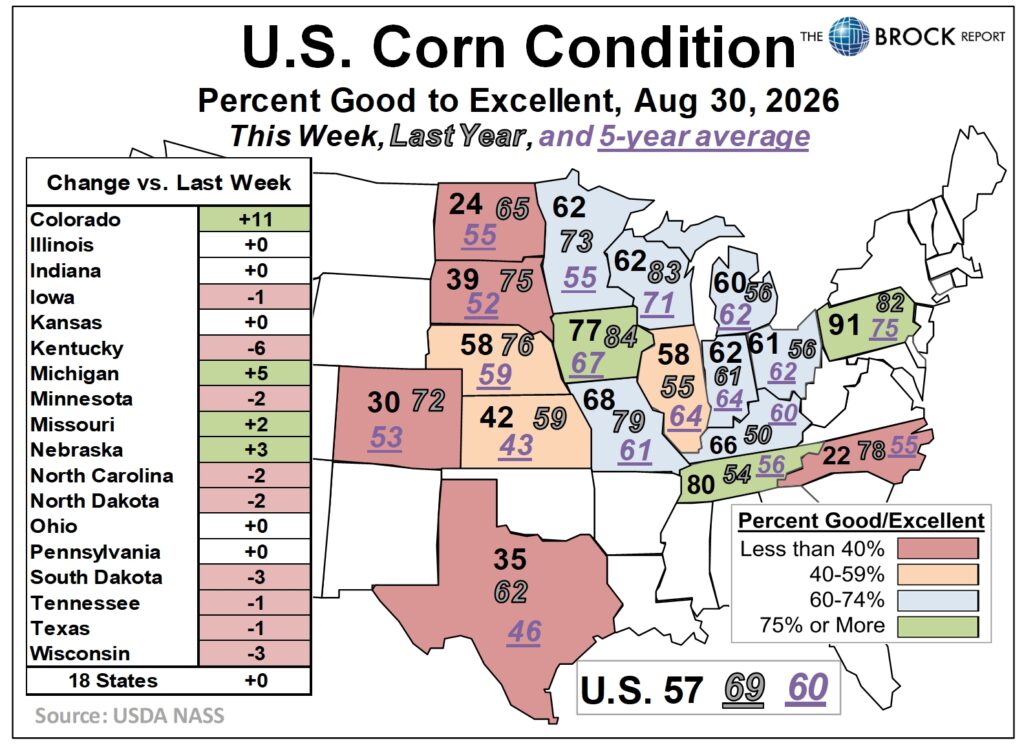
USDA this afternoon reported that 57% of the corn crop was good/excellent as of Sunday, steady with a week ago. The trade was on average expecting a one-point decline. But at this point the ratings of are limited significance as harvest nears. USDA reported that 62% of the crop was dented versus 45% last week, and the five-year average of 56%. Most states are near their five-year average. One exception is Minnesota, where the crop is 68% dented versus an average of 43%. Overall the report should have little market impact.
While the market had support from a surging crude oil market that rallied amid renewed attacks between Iran and the U.S, corn bulls had to overcome strong pressure from the wheat market today. Along with the decline in U.S. corn yield expectations over the past month, corn also has support from strong export demand. That continued to start the week, as USDA this morning reported weekly corn inspections of 1.496 MMT, up from 1.323 MMT the prior week and topping trade guesses of 1.15 to 1.25 MMT.
More attention will fall on South American weather as the month of September progresses, although for now it is still very early. First crop corn planting in center-south Brazil was 11% done as of last Thursday, AgRural said, up from 2% the prior week and from 7% a year ago. Most of the planting is in southern Brazil, which is typical for this time of year. The weather outlook for now is generally favor-able, with central and northern areas of Brazil expected to see ample rains over the next 10 days, which will be generally welcomed by farmers. There are still longer-term concerns about the impact of a strong El Nino on this coming year’s crop.
SOYBEAN COMMENTS
NO NEW RECOMMENDATIONS
Soybeans also had an up-and-down day and settled mixed to slightly higher, with deferred contracts leading modest gains while nearby months lagged. September soybeans fell 1 cent to settle at $12.7525, the benchmark November contract finished unchanged at $12.88 after trading between $12.7725 and $12.945, January gained a half-cent to $13.0325, and March rose 2.5 cents to settle at $13.09.
The soybean market had late help from a rebound in soybean oil, which was down sharply early in the session amid anticipation of EPA’s plan to increase RFS waivers for oil refiners, before rallying late. Soyoil gained 1 to 16 points in most contracts. December soyoil settled at 71.12, near the day’s high of 71.38 after earlier trading as low as 69.88. Soybean meal futures meanwhile were down $1.50 to $3.90. Most-active December soymeal settled down $3.60 to $345.30.
As noted this morning USDA reported another soybean flash export sale this morning, this one for 159,000 metric tons to “unknown destinations,” which the market assumed to be China. While the new crop demand continues to roll in, with the 2025-26 marketing year ending weekly export inspections this morning were disappointing at just 250,801 metric tons. That is down from 430,079 the prior week and well shy of trade guesses that ranged from 400,000 to 600,000.
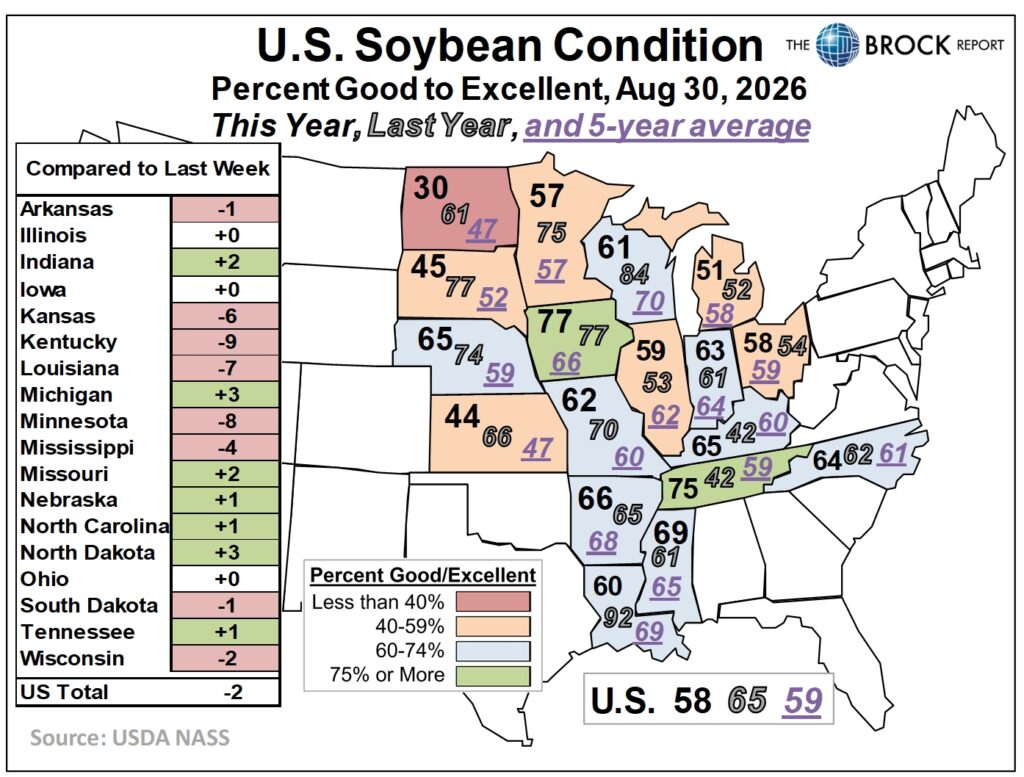
USDA this afternoon reported 58% of the soybean crop rated good/excellent, down two points from last week and a point below the average trade estimate, which could give the market a further boost on Tuesday. USDA said that 13% of the crop was dropping leaves, up from 6% last week and the five-year average of 9%. Southern states, including Mississippi, Arkansas, Kentucky and Tennessee are all ahead of average, as hot and dry weather in recent weeks has accelerated crop development.
Midwest weather is of diminishing market importance but not yet irrelevant, and as the calendar turns to September the weather outlook is a mixed bag. Southern areas of the Corn Belt and into the Delta remained hot and dry over the weekend, rapidly bringing the crop to maturation and close to harvest. Areas of the central and especially northern Corn Belt did see healthy rains, which were particularly welcome in the northwest Corn Belt, where yields will likely benefit according to World Weather. Over the next couple of weeks, net drying will be widespread across the region, with hot and mostly dry conditions. In areas that didn’t get as much rain in August, the pattern is less than ideal and puts late stress on corn and soybean crops.
WHEAT COMMENTS
NO NEW RECOMMENDATIONS
While corn and soybeans were up and down today, wheat was sharply lower from the outset last night and settled lower Monday, although the market did finish well off its lows.
In Chicago, wheat futures fell 4.75 to 10.5 cents across active crop-year contracts. September Chicago settled down 10.5 cents at $7.565 after trading between $7.4125 and $7.67, December dropped 10 cents to finish at $7.74 after recovering from an intraday low of $7.5575, and March settled at $7.8825. Kansas City hard red winter wheat was also down, with active crop-year contracts dropping 1.5 to 7.5 cents while similarly rebounding from sharp overnight losses. September hard red winter wheat settled down 7.5 cents at $8.2025 after trading between $8.02 and $8.2725, December shed 6.25 cents to finish at $8.38 after hitting a low of $8.165, and March settled at $8.5125. Minneapolis spring wheat was down 5 to 6.25 cents, with September settling down 6 cents at $7.3925 after trading between $7.2575 and $7.4425, December finishing at $7.63, and March settling at $7.82.
The spring wheat crop was 77% harvested as of Sunday, USDA said this afternoon, up from 62% last week and a little ahead of the average trade estimate of 75%. All states are at or ahead of their average pace except for Montana, which was 66% harvested versus the five-year average of 77%. North Dakota was 75% harvested versus the average of 58%.
Weekly wheat export inspections of 430,925 metric tons were virtually unchanged from the prior week, and at the upper end of trade guesses that ranged from 250,000 to 450,000.
Amid all of the concern about the war between Ukraine and Russia cutting off exports out of the Black Sea, both countries are scrambling to find alternate routes. Russia is rerouting shipments through the Baltic Sea, including ports in the Baltic states, and Reuters reports it is increasingly looking to ports in the Baltic states, mainly Latvia, which is an EU and NATO member. Shipments there are expected to spike next month. Meanwhile Ukraine exports of wheat, corn and barley were actually up in the week ended Aug. 26, the APK-Inform consulting firm said Sunday, amid increasing efforts to ship grain out of Danube ports.
COTTON AND RICE COMMENTS
NO NEW RECOMMENDATIONS
Cotton bulls continued to flex their muscles, as futures rebounded sharply after a weak Sunday night open to post strong gains while making fresh contract highs. Active crop-year contracts gained 170 to 180 points. Thinly traded October settled at 91.70 cents per pound. The most-active December contract settled at 93.14 cents after trading between a low of 90.60 and a high of 93.74, while March cotton finished at 95.14 cents after trading between 92.69 and 95.59.
USDA reported the cotton crop at 39% good/excellent as of Sunday, up two points from the prior week. The rating in Texas is just 22%, while in Georgia it is at 62%. The poor/very poor rating also increased, to 32% from 29% last week. In Texas, that percentage is 47%. USDA said 29% of the U.S. crop had open bolls, up from 20% the prior week and the average of 28%.
Both cotton and rice have some support from worries about conditions in India. India is likely to receive below-average monsoon rainfall again in September after August rains were down 16% from normal, the government’s weather department said Monday. The forecaster said September rainfall is expected at less than 91% of the long-term average, with above-average temperatures as well. This poses a threat to yields for cotton as well as rice. The monsoon season provides about 70% of the country’s annual rainfall.
Rice futures also rallied to new contract highs and settled with strong gains. Active contracts advanced 17 to 20 cents. September rice settled at $15.25 per cwt after trading between a low of $15.20 and a high of $15.25, while November rice finished at $15.725 after reaching an intraday high of $15.805.
USDA said the rice crop was 71% good/excellent as of Sunday, up three points from a week earlier. The harvest is 38% done, up from the five-year average of 27%. In Arkansas, 33% of the crop was harvested, up from 16% the prior week and the five-year average of 18%.
LIVESTOCK COMMENTS
NO NEW RECOMMENDATIONS
Picking up where they left off on Friday, LEAN HOG FUTURES rallied, posting gains of more than $1.50 in most contracts amid technically-driven short-covering and bottom-picking after the market surged late to end last week. October lean hogs gained $1.775 to $83.675, December was up $1.85 to $74.15, and February was up $1.55 to $76.525.
The afternoon pork carcass cutout value was up $1.61 to $97.67, USDA said. Cash prices were softer, with the afternoon negotiated cash carcass price down 84 cents. The CME Lean Hog Index is expected at $90.86 for Friday. Pork packer margins are at an average of $4.00 per head today according to HedgersEdge, compared to $2.70 a week ago.
Monday’s trade was more quiet for LIVE CATTLE FUTURES, which posted modest gains. August live cattle go off the board up $1.50 to $220.75. October settled up 95 cents to $212.675, and December was up 85 cents to $214.575. Technically, after breaking below a six-year trend line last week, today’s rally does not change the longer-term negative outlook. There is near-term support at last week’s major low of 209.525. But major support on a continuation chart is at the November 2025 low of $200.33. If futures build on their gains tomorrow, the next target is Thursday’s high of $214.225.
The afternoon Boxed Beef report showed Choice down 41 cents and Select down $2.59. Prices had also been lower this morning, by $1.03 for Choice and $6.57 for Select (not higher as we mistakenly said in mid-session comments). Beef packer margins remain in positive territory, with HedgersEdge today reporting the average margin at $110.75, compared to $119.75 per head a week ago. The outlook for Plains cash trade is for soft prices this week with buyers purchasing for a holiday-shortened week.
Feeder cattle futures also posted modest gains, holding above the significant lows posted last week. September feeders were up 55 cents to $321.45, October was up 50 cents to $317.025, and November was up 50 cents to $310.425. The CME Feeder Cattle Index for Friday was at $329.31, down from $332.80 the prior day.
NOTE: Along with the potential for profit, there is always a risk of losing money when trading futures and options contracts.
Copyright 2026 by Richard A. Brock & Associates, Inc.
Any unauthorized redistribution or reproduction of this commentary is strictly forbidden.
Click Here to View THE BROCK REPORT Position Monitor
NOTE: Along with the potential for profit, there is always a risk of losing money when trading futures and options contracts.
Copyright 2026 by Richard A. Brock & Associates, Inc.
Any unauthorized redistribution or reproduction of this commentary is strictly forbidden.