This coming Monday, USDA will release both its annual Crop Production Summary report for 2025 and its quarterly Grain Stocks report. The Crop Summary report will give the markets a better handle on 2025/26 supplies, while the Grain Stocks report will provide traders with an indication of overall demand strength for the first quarter of the marketing year and Dec. 1 stocks for corn, soybeans and wheat. By the time most of you read this, you will already have seen USDA’s actual Dec. 1 stocks estimates, but we still want to take the time to discuss Q1 usage and provide our estimates of Dec. 1 stocks.
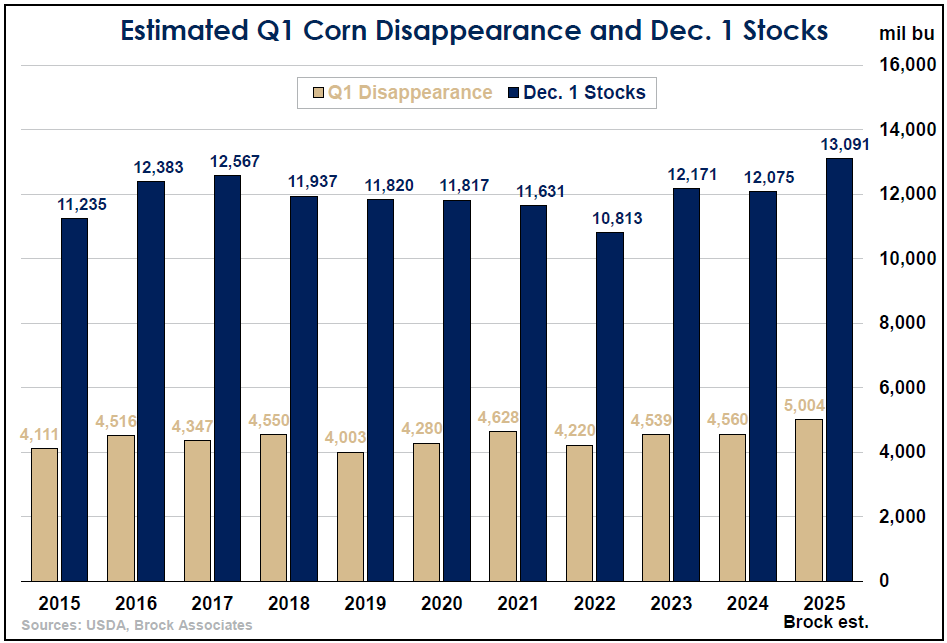
Looking at corn, we estimate Dec. 1 corn stocks at a record high 13.091 billion bushels, up 1.016 billion or 8.4% from 2024/25. This is primarily due to the record large U.S. crop and record total supplies entering the marketing year. We expect the report to imply total September-November corn disappearance was also record large at 5.004 billion bushels, up 9.7% from 2024/25, thanks in large part to huge quarterly exports, which we estimate were up 70% versus a year earlier. Q1 corn-for-ethanol use was virtually unchanged from last year, which is disappointing with USDA forecasting a 2.5% rise in annual use. As always, the big wild card in the corn use picture is feed/residual use, which is an implied number, since USDA does not survey feed use. We believe USDA’s annual feed/residual use forecast for 2025/26 of 6.100 billion bushels is about 200 million too high, based on last year’s use. We still expect Monday’s report to imply Q1 feed/residual use was up 7.8% versus last year.
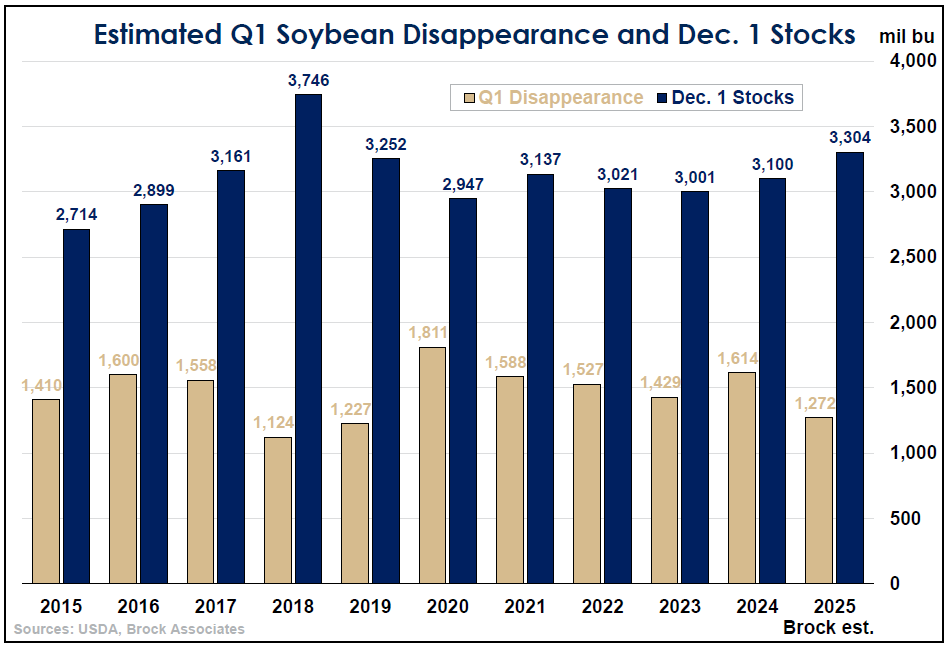
We expect USDA to peg Dec. 1 soybean stocks at a seven-year high of 3.304 billion bushels, largely due to low September-November soybean disappearance resulting from a sharp drop off in quarterly exports. We estimate total Q1 soybean disappearance at a six-year low of 1.272 billion bushels, with Q1 exports at just 463 million bushels, down 44.3% versus a year earlier to a 14-year low. The plunge in soybean exports more than offset an increase of 50 million bushels or 8.2% in the Q1 U.S. soybean crush to nearly 662 million bushels. Soybean feed/residual use, a “fudge factor” USDA uses to balance supply with demand, varies widely from year to year. Based on the 10-year average, we have estimated Q1 feed/residual use at 147 million bushels.
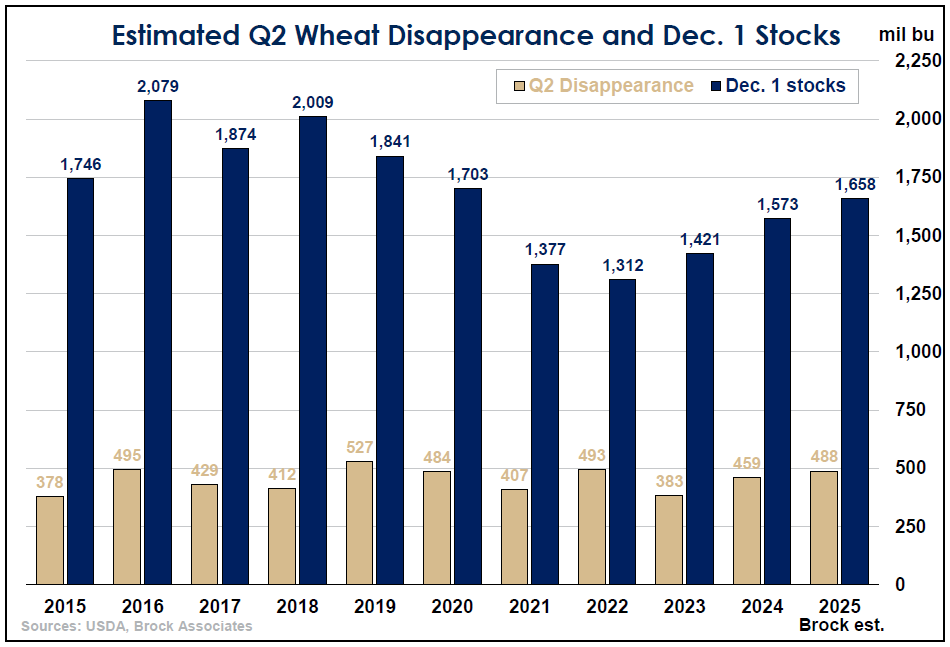
We estimate Dec. 1 wheat stocks at a five-year high of 1.658 billion bushels, up 5.4% from last year, even though September-November wheat disappearance was the highest in three years at 488 million bushels, up 29 million or 6.3% versus 2024/25. We estimate Q2 wheat exports at 251 million bushels, the highest in 12 years, with Q2 food/seed use up a marginal 3 million bushels. Q2 feed/residual use, an implied number, is estimated at minus 57 million bushels, based on the 10-year historical average.